
There's something about standing beneath a real Saturn V rocket, or coming face to face with Space Shuttle Atlantis, tilted at its famous 43.21-degree operational angle, that has a way of getting under your skin.
We think everyone should get to feel that, and Kennedy Space Center Visitor Complex clearly agrees: wheelchair and ECV rentals, accessible buses, thoughtful sensory support and Certified Autism Center status are all woven into the visit.
That said, "wheelchair accessible" doesn't always mean every part of an experience can be enjoyed in exactly the same way, and a handful of attractions come with their own transfer, height or sensory requirements. A little planning goes a long way here, so we've pulled together everything you'll want to know before you go, from the practical (parking, rentals, restrooms) through to the finer detail of individual attractions.
Key takeaways:
- Kennedy Space Center Visitor Complex offers wheelchair and ECV rentals, accessible parking, accessible restrooms and companion/family restrooms, and wheelchair-accessible tour buses.
- Most major attractions, including Space Shuttle Atlantis, the Kennedy Space Center Bus Tour, Apollo/Saturn V Center, IMAX and Rocket Garden, are wheelchair accessible throughout.
- The Shuttle Launch Experience is wheelchair accessible, but its simulator seat requires a transfer. A Launch Observation Room is available for anyone who can't or would rather not transfer.
- Kennedy Space Center is a Certified Autism Center, with a Sensory Guide, quiet zones, noise-reduction headphones and a Guest Accessibility Pass (GAP) available on arrival.
- Service animals are welcome across most of the complex, though a small number of motion-based attractions restrict them for the animal's safety.
Wheelchair and mobility access
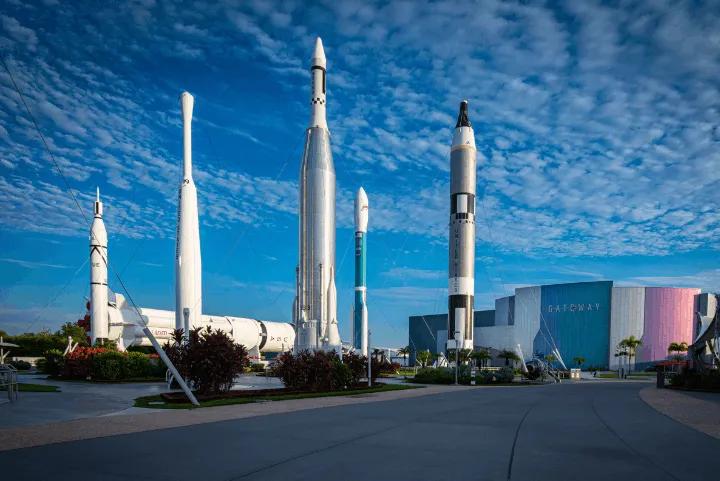
Getting around the main Visitor Complex by wheelchair or ECV is refreshingly straightforward. Wide, paved, step-free pathways link every major pavilion, so you can move between the Rocket Garden, Atlantis and the rest of the complex without hunting for a workaround.
Wheelchair and ECV rentals
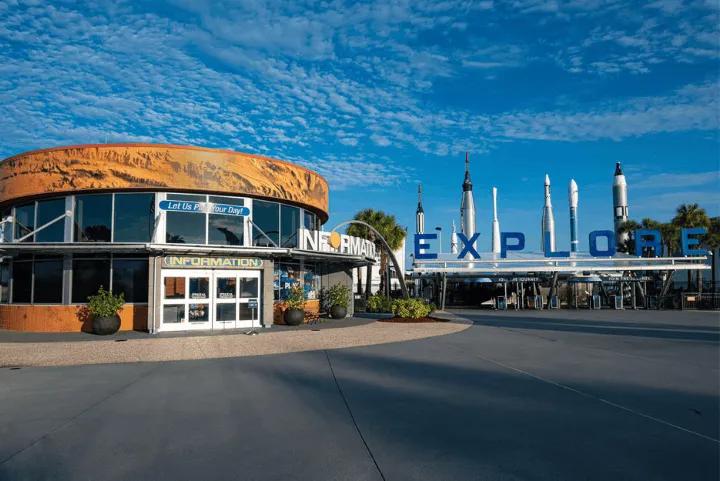
If you'd like to rent a wheelchair or an Electric Convenience Vehicle (ECV, or mobility scooter) for the day, you'll find them at the Information building near the main entrance. You can book online in advance or simply turn up and rent one on a first-come, first-served basis.
A manual wheelchair costs $10 plus tax for the day, and an ECV costs $30 plus tax. ECV numbers are limited, though, so if one's essential to your day, we'd always recommend booking ahead rather than leaving it to chance.
A few rules to know before you book:
- You must be 18 or older to operate an ECV.
- ECVs are single-rider vehicles, so young children can't operate or ride along.
- You'll need to sign a rental agreement confirming you understand how to use it.
- Rental equipment needs to be returned to the Information Center before the complex closes.
Bringing your own mobility device
Prefer to bring your own wheelchair or mobility device? You're very welcome to. The accessible routes, tour buses and Shuttle Launch Experience gantry are all designed with standard wheelchairs and ECVs in mind.
If you use a larger power chair or a specialist piece of equipment, it's worth giving Kennedy Space Center a call before you travel to check it'll be accommodated on the buses and at individual attractions.
Accessible parking
Accessible parking is available in Lot 5, just a short distance from the Visitor Complex entrance, for vehicles displaying a valid accessible parking permit. Standard parking rates apply: $15 for a standard automobile, $5 for motorcycles and $20 for oversized vehicles or RVs. If you’ve forgotten your permit, temporary ones are available at the ticket windows.
Accessible toilets and companion restrooms
Accessible restroom stalls are dotted throughout the Visitor Complex, and private, single-user companion/family restrooms can be found near Guest Services at the entrance plaza, inside the Space Shuttle Atlantis pavilion, and at the Apollo/Saturn V Center, giving you extra privacy and floor space.
These only have standard infant changing tables rather than adult ones, and Kennedy Space Center doesn't currently offer dedicated Changing Places-style facilities, so there are no hoists, tracking systems or powered, height-adjustable changing tables on-site.
If an adult change is needed during your visit, the First Aid station is the best option. It has adjustable medical beds and a private space, and staff can grant access on request.
Wheelchair-accessible buses
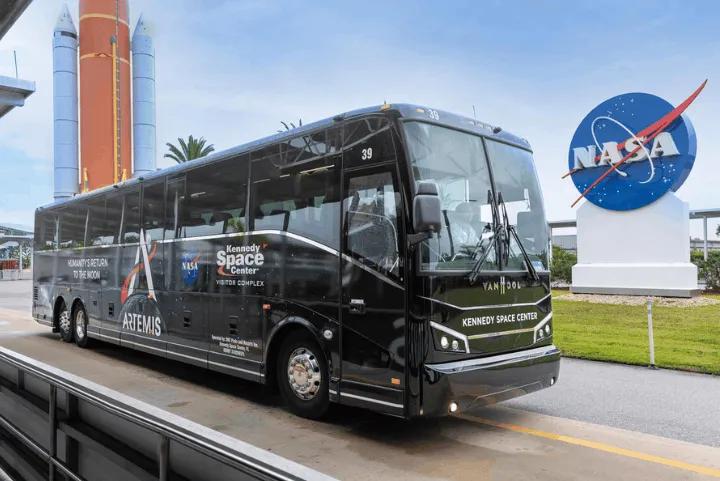
Every Kennedy Space Center tour bus comes fitted with a wheelchair and scooter lift, so you can simply request it at the boarding area and stay in your own chair for the whole journey.
Prefer to transfer into a standard bus seat instead? That works too, and a loaner wheelchair is usually available at the Apollo/Saturn V Center on a first-come, first-served basis.
Getting around the 42-acre complex
Kennedy Space Center is a big place to explore, so even where every route is completely step-free, distance, heat and standing time can become their own kind of accessibility challenge over a full day. That matters if you have limited stamina, chronic pain or another condition that isn't always visible.
Our advice would be to build your day around a mix of indoor and outdoor attractions, with regular breaks, rather than trying to cover the whole complex in one sweep. An ECV or wheelchair can make a real difference here, even if you wouldn't normally use one day to day.
Accessible attractions
Most of the major attractions at Kennedy Space Center are wheelchair accessible, though accessibility at the venue and accessibility of a specific experience aren't always quite the same thing. A handful of attractions, particularly those with simulators or motion effects, ask you to transfer out of your wheelchair for part of the experience, and thoughtfully offer an alternative if that isn't possible.
Space Shuttle Atlantis
- Wheelchair access: Ramps and an elevator connect every viewing level, so you can explore the main exhibition entirely by wheelchair as you get up close to the shuttle itself.
- Good to know: Some individual interactive elements inside, such as the flight simulators, may have their own physical requirements, but you don't need to use these to enjoy the main exhibit.
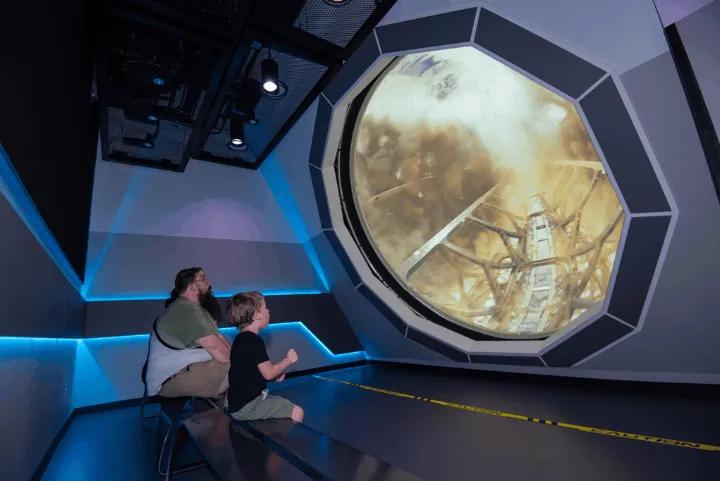
Shuttle Launch Experience
This is the attraction where planning ahead matters most.
- Wheelchair access: You can wheel straight into the pre-launch briefing.
- Transfer: Each crew cabin has a dedicated accessible seat with a pivoting grab bar and a five-point harness, letting you transfer directly from your wheelchair into the seat for the simulation itself.
- Requirements: A minimum height of 44 inches (112cm), along with mobility, height and weight requirements.
- Alternative: If you can't or would rather not transfer, a Launch Observation Room next to the crew cabin shows the simulation on screen, so you still get to experience the launch and reunite with the rest of your party the moment it's over.
Kennedy Space Center Bus Tour
- Wheelchair access: Accessible from start to finish, with lifts to help you board without leaving your chair.
- Good to know: It's also your route to the Apollo/Saturn V Center, so it's well worth building into your day.
Apollo/Saturn V Center
- Wheelchair access: Level flooring and elevators run throughout, with front-row viewing areas reserved for wheelchair users.
- Good to know: If you transferred to a bus seat on the way over, a loaner wheelchair is usually waiting for you here on a first-come, first-served basis.
IMAX
- Wheelchair access: Ground-level entrance, wheelchair-accessible seating and companion seating, with a lift up to the premium upper tier if that's where you'd like to sit.
- Good to know: It does feature heightened visual and motion effects, so it's worth keeping in mind if you're planning around sensory needs.
Rocket Garden
- Wheelchair access: Paved, step-free pathways wind between the historic rockets, making it one of the more accessible outdoor spaces at the complex.
- Good to know: As it's entirely open-air, Florida's heat and sun are really the main thing to plan around here, rather than the terrain.
Universe Theater
- Wheelchair access: Wheelchair-accessible and companion seating throughout.
Spaceport KSC
- Wheelchair access: Yes, though it's a motion-theatre attraction with its own considerations.
- Alternative: If you'd rather not experience the motion, an observation option is available.
- Good to know: Service animals aren't permitted here, for their own safety - see our service animals section below.
Attractions with restrictions
A small number of experiences have their own physical requirements beyond the attractions above. The Astronaut Training Experience (ATX) is wheelchair accessible as a venue, but participants generally need to be able to transfer independently into the simulators.
All ATX simulators carry a maximum weight limit of 275lb (127kg), and each has its own minimum height requirement: 51 inches (130 cm) for the Lander/Rover simulator and 48 inches (122 cm) for the Microgravity simulator.
Thinking about the KSC Explore Tour rather than the standard Bus Tour? This tour visits active, roadside and unpaved photo stops, such as the Vehicle Assembly Building, where the bus's wheelchair lift can't always be deployed safely. The standard Bus Tour is your best bet for an uninterrupted, fully accessible experience.
Autism and sensory accessibility
This is where Kennedy Space Center really shines. The Visitor Complex is a Certified Autism Center™, working with the International Board of Credentialing and Continuing Education Standards (IBCCES), and its front-line staff complete specialised autism awareness and sensitivity training.
Sensory Guide
The IBCCES Sensory Guide is available online, through the app and on-site, and rates how each attraction affects sound, sight, touch, taste and smell on a scale of 1 to 10, so you know roughly what to expect before you commit your day to it.
Sensory-friendly signage is dotted around the complex too, giving you a heads-up before loud noises, bright lights or busier areas.
Quiet and low-sensory areas
If the day gets a little much, designated quiet, low-sensory areas are available across the complex, including dedicated quiet rooms inside Space Shuttle Atlantis, at the Gantry at LC-39, and at the Apollo/Saturn V Center. The complex map and the Information Center on arrival are the best places to check for the day's exact locations, as availability can shift.
Noise-reduction headphones
A limited number of noise-reduction headphones can be borrowed for free from the Information Center on a first-come, first-served basis, and need to be returned before the complex closes. If noise reduction is essential for your visit, we'd suggest bringing your own as a backup too, since supplies are limited.
Guest Accessibility Pass (GAP)
The Guest Accessibility Pass is available from the Information Center and is designed to let staff know your party may need some extra support. One thing to flag: GAP doesn't let you skip queues or guarantee priority boarding. What it does do is help staff understand your needs so they can offer the right assistance as you go.
Hearing and visual accessibility
ASL interpretation
American Sign Language interpretation is available for live presentations and tours, free of charge, but needs to be requested at least two weeks before your visit through Guest Services. This is one of the few things we'd always suggest arranging well ahead of time rather than asking on the day.
Closed captions and hearing loops
Captioning is available on several major experiences, including English closed captions on Bus Tour video monitors, a reflective captioning panel at the Shuttle Launch Experience pre-launch briefing, and a Do Re Mi Audio Interface device at IMAX.
Provision does vary by attraction, though, so check ahead if captioning is essential for a specific experience. Hearing loops are also available at ticket windows, IMAX and the Universe Theater, transferring audio directly to hearing aids and cochlear implants.
SmartGuide
The free KSC SmartGuide app is a great companion for the day, offering audio content, facts, photos and video in multiple languages, plus American Sign Language video translations at points of interest. It's complimentary for guests with vision impairments, and can be rented by everyone else.
Visitors who are blind or have low vision
A complimentary day-of orientation is available through the Information Center for visitors who are blind or have low vision, giving you a short introduction to the space programme and the layout of the complex, with no advance booking needed.
The Apollo/Saturn V Center is also home to a genuine piece of the Moon that you can reach out and touch, one of a number of tactile experiences woven through the complex.
Service animals
Trained service animals, including those used to perform tasks for a person with a disability, are welcome across most of Kennedy Space Center, including exhibits, presentations and the Bus Tour.
For safety reasons, a small number of motion-based or sensory-heavy attractions don't permit service animals, including the Shuttle Launch Experience and Spaceport KSC. Complimentary, climate-controlled kennels are available on-site on a first-come, first-served basis, so your animal has somewhere comfortable to wait while you experience one of these attractions.
Tips for an accessible visit
- Plan your day in advance. Reserve an ECV or wheelchair if you'll need one, and request ASL interpretation at least two weeks ahead if that applies to you.
- Check individual attraction requirements. The Sensory Guide and each attraction's own accessibility information will tell you far more than a general "wheelchair accessible" label ever could.
- Arrive early if you're hiring mobility equipment. Rental numbers are limited, particularly for ECVs, so getting there when the complex opens gives you the best chance of securing one.
- Take regular breaks. With a 42-acre site to explore, building in downtime helps manage fatigue, especially if you're travelling with sensory needs or limited stamina.
- Stay hydrated and plan around Florida's heat. Alternate outdoor attractions like Rocket Garden with air-conditioned spaces such as IMAX or the theatres to keep your day comfortable.
- Speak to the Information team when you arrive. This is your first stop for a GAP, mobility equipment, the day-of orientation, noise-reduction headphones or any attraction-specific questions.
- Allow extra time between attractions. Accessible boarding, lifts and transfers can all take a little longer than the standard visitor route, so build that into your schedule rather than rushing between pavilions.
Ready to visit Kennedy Space Center?
Kennedy Space Center Visitor Complex has clearly put real thought into welcoming visitors with mobility, sensory, hearing and visual needs, from its accessible buses and restrooms through to its Certified Autism Center status.
Our best advice is to treat "wheelchair accessible" as your starting point rather than the full picture, and check the details for the specific attractions and services that matter most to your visit.
With a little planning around ECV rentals, ASL interpretation and any transfer requirements, you can build a day among the rockets that works for your whole family, and one that's every bit as inspiring as it should be.
Book your tickets to Kennedy Space Center now!
Frequently asked questions
Is Kennedy Space Center accessible for wheelchair users?
Yes. Kennedy Space Center Visitor Complex offers wheelchair and ECV rentals, accessible parking, accessible restrooms and wheelchair-accessible tour buses, and most major attractions, including Space Shuttle Atlantis, the Bus Tour, Apollo/Saturn V Center, IMAX and Rocket Garden, are wheelchair accessible throughout.
A small number of attractions, such as the Shuttle Launch Experience, ask you to transfer out of your wheelchair for part of the experience, with an alternative available if you'd rather not.
Do I need to transfer out of my wheelchair for the Shuttle Launch Experience?
The accessible simulator seat is designed for you to transfer into from your wheelchair, using a pivoting grab bar and five-point harness. If you can't or would rather not transfer, a Launch Observation Room lets you watch the simulation on screen and reunite with your party straight afterwards.
How much does it cost to rent a wheelchair or ECV at Kennedy Space Center?
A manual wheelchair currently costs $10 plus tax for the day, and an ECV costs $30 plus tax. Rentals can be arranged online in advance or on a first-come, first-served basis at the Information Center near the main entrance, and we'd recommend booking ahead if an ECV is essential to your visit, as numbers are limited.
What does the Guest Accessibility Pass do?
The GAP doesn't let you skip queues, but it lets staff know your party may need extra support, helping them offer the right assistance with boarding, seating or other accommodations as you go. You can pick one up from the Information Center on arrival.
Is Kennedy Space Center a good visit for autistic visitors or those with sensory sensitivities?
Yes. Kennedy Space Center is a Certified Autism Center, with specially trained staff, a Sensory Guide rating each attraction's sensory intensity from 1 to 10, sensory-friendly signage, designated quiet areas and a limited supply of noise-reduction headphones available to borrow.
Can I bring my service animal to Kennedy Space Center?
Trained service animals are welcome across most of the complex, including exhibits, presentations and the Bus Tour. A small number of motion-based attractions, such as the Shuttle Launch Experience, don't permit service animals for the animal's safety, and complimentary kennels are available if you need somewhere for them to stay during those experiences.
What support is available for visitors who are blind or have low vision?
Kennedy Space Center offers a complimentary day-of orientation through the Information Center, no advance booking required, along with the free KSC SmartGuide app for audio content and tactile experiences such as touching a genuine piece of the Moon at the Apollo/Saturn V Center.
Is ASL interpretation available at Kennedy Space Center?
Yes, free of charge for live presentations and tours, though it needs to be requested at least two weeks before your visit through Guest Services.
How accessible is Kennedy Space Center for visitors who tire easily or have limited stamina?
Kennedy Space Center covers 42 acres, so distance and Florida's heat can be tiring even where every route is step-free. We'd suggest pacing your day with a mix of indoor and outdoor attractions, regular breaks, and considering a wheelchair or ECV rental even if you wouldn't normally use one, to help manage fatigue over a full day.


